
Susquehanna Township Previous Residents Sources
A backward address trail uses sources with different date ranges and different purposes. The Recorder supplies the ownership and document layer. Devnet supplies current and selected annual parcel-card views. Harrisburg directory collections add published name, address, and usually occupation information for available years. Census, newspaper, map, permit, church, cemetery, and estate material fill particular gaps. The source that starts the search should match the time period, not simply be the first result returned by a name query.
| Source | Years it covers | Where held | What it contributes |
|---|---|---|---|
| Recorder deeds and miscellaneous records | 1785 to present | Dauphin County Recorder / Acclaim | Recorded ownership, parties, legal description, plans, and easements. |
| Recorder mortgages | 1979 to present | Dauphin County Recorder / Acclaim | Mortgage, assignment, release, and satisfaction trail. |
| County property cards | 2001 to 2026 selector on inspected sample | Dauphin County Devnet | Tax-card state, owner/mailing/site fields, assessments, and sale history. |
| Harrisburg directories | Documented runs from 1839 to 1999, with gaps | HSDC Alexander Library | Published households/businesses; some volumes have street sections. |
| Directory microfilm and newspapers | Directories 1861 to 1901; newspaper 1946 to 2015 | East Shore Area Library | Address leads, obituaries, notices, and street browsing. |
| Federal census | 1790 to 1950, except the 1890 loss | NARA and archive channels | Household, age, relationship, birthplace, and decade snapshot. |
The source history contains an important split: Dauphin County states its deeds and miscellaneous documents reach 1785, while mortgages begin at 1979. That makes a deed-chain question different from a mortgage question. For a pre-deed or early family question, HSDC’s will and Orphans’ Court extracts, church records, cemetery material, and State Archives land-office records can be useful leads.
Susquehanna Township Parcel Card Start
Begin the previous-residents trail with the current property card rather than a person name. Search the address in the Dauphin County Property Tax Inquiry, then record the Parcel Number, Site Address, Owner Name & Address, Mailing Name & Address, tax year, and sale-history document number. The County’s inspected Township sample permits annual card selection from 2001 through 2026. That is verified display coverage for the card, not a claim that every field or image is complete for every year.
The site address identifies the physical parcel. The mailing address tells the County where notices go, and it may be a post-office box, business, trust, agent, or nonresident owner address. Do not turn either value into a claim about every person who lived at the property. The sale-history document number and the UPI are the two most useful next links into Recorder Acclaim.
Susquehanna Township Previous Residents Deed Chain
Recorded deeds trace a chain of title, meaning the sequence of documented land transfers. They are the ownership half of a previous-residents search, not the whole household story. Start with the current parcel and its sale document, retrieve that recorded instrument, then copy its legal description and prior-deed recital before moving backward. The legal description, plan/lot/block information, book/page, instrument number, and UPI are more durable than a street number when a road has been renamed or a parcel has been subdivided.
- Use the Devnet parcel card to save today’s owner, UPI, site address, and sale-history instrument or document number.
- Open Recorder Acclaim and search by UPI Number, Instrument#, Book/Page, or a recorded party to retrieve the current deed.
- Record the grantor, grantee, recording date, legal description, plan/lot/block details, and any earlier deed cited in the instrument.
- Search the seller as a grantee, then compare the legal description and record references to identify the prior acquisition.
- Repeat one transfer at a time. When an image is unavailable, use the Recorder counter and its official copy procedure rather than treating a failed web view as an absent deed.
- Grantor
- The party transferring an interest in a recorded document.
- Grantee
- The party receiving that interest. A later grantor is often a prior grantee, but estate, corporate, court, and boundary events can complicate the pattern.
- Chain of title
- The sequence of recorded transfers and related documents for a parcel.
- Legal description
- The lot, block, plan, metes-and-bounds, or parcel language identifying the land more precisely than a changing street address.
Use the deed itself, not only a tax-card sale row. A $1 consideration or a combined transfer can reflect a family, government, corrective, or other transaction and is not a market-value conclusion.
Note: Estate transfers, corporate changes, boundary adjustments, and rerecordings can interrupt a simple grantor-to-grantee sequence.
Dauphin Deed Dates for Susquehanna Township
The Recorder’s public Acclaim interface has separate Simple Search, Name, Instrument#, Doc Type, Book/Page, Record Date, Consideration, UPI Number, Municipality/Comments, and Alpha Index modes. For an address trail, the UPI and instrument-number paths are especially helpful because they link a parcel-card lead to a recorded document. Name searching is still useful when a deed gives a prior party, but use the legal description or book/page to avoid blending unrelated properties with the same surname.
The Recorder name-search screen supports last-name-first queries, document-type choices, and date controls for the recorded-document index.
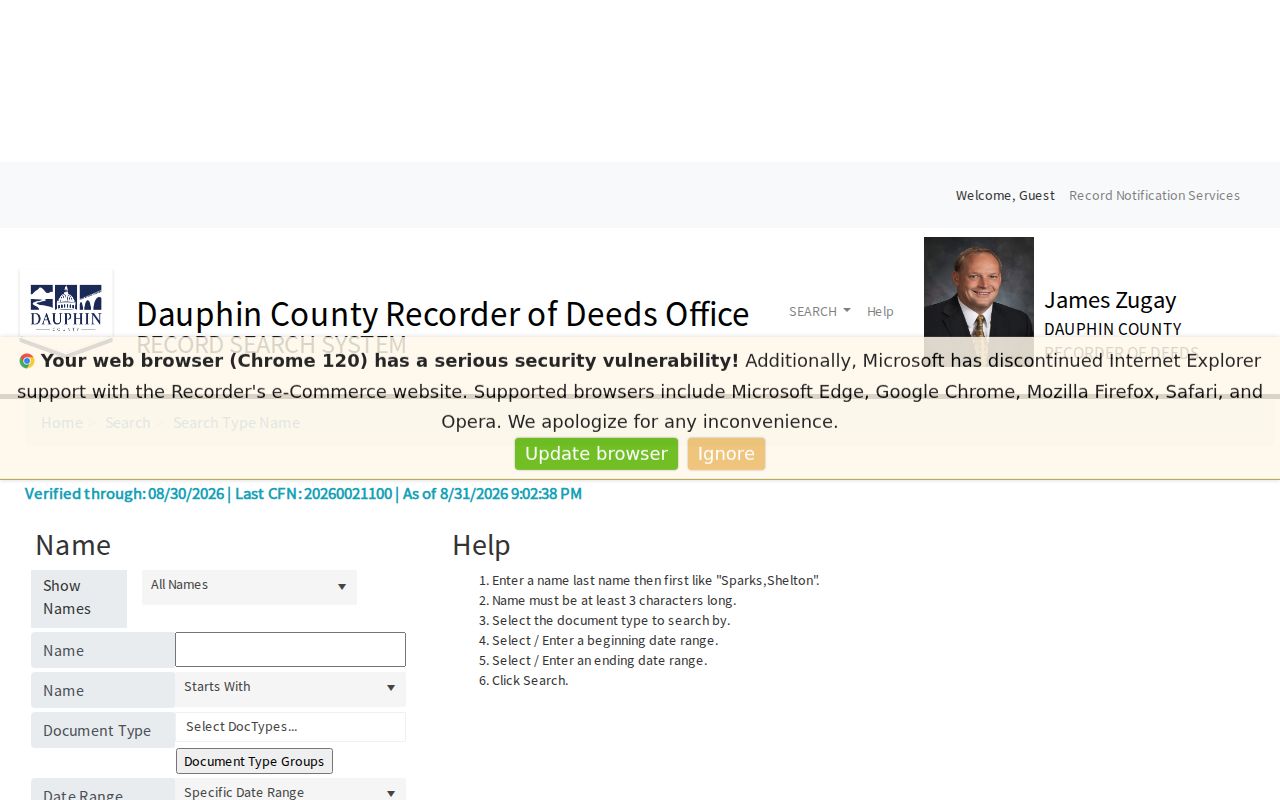
Deed, corrected deed, plan, easement, mortgage, release, lien, judgment, and name/address-change categories serve different purposes. A plan can translate an older lot or block to the current parcel. A mortgage release may confirm a loan event, but it does not itself transfer ownership.
The Recorder Alpha Index provides a separate search mode with volume and name controls.
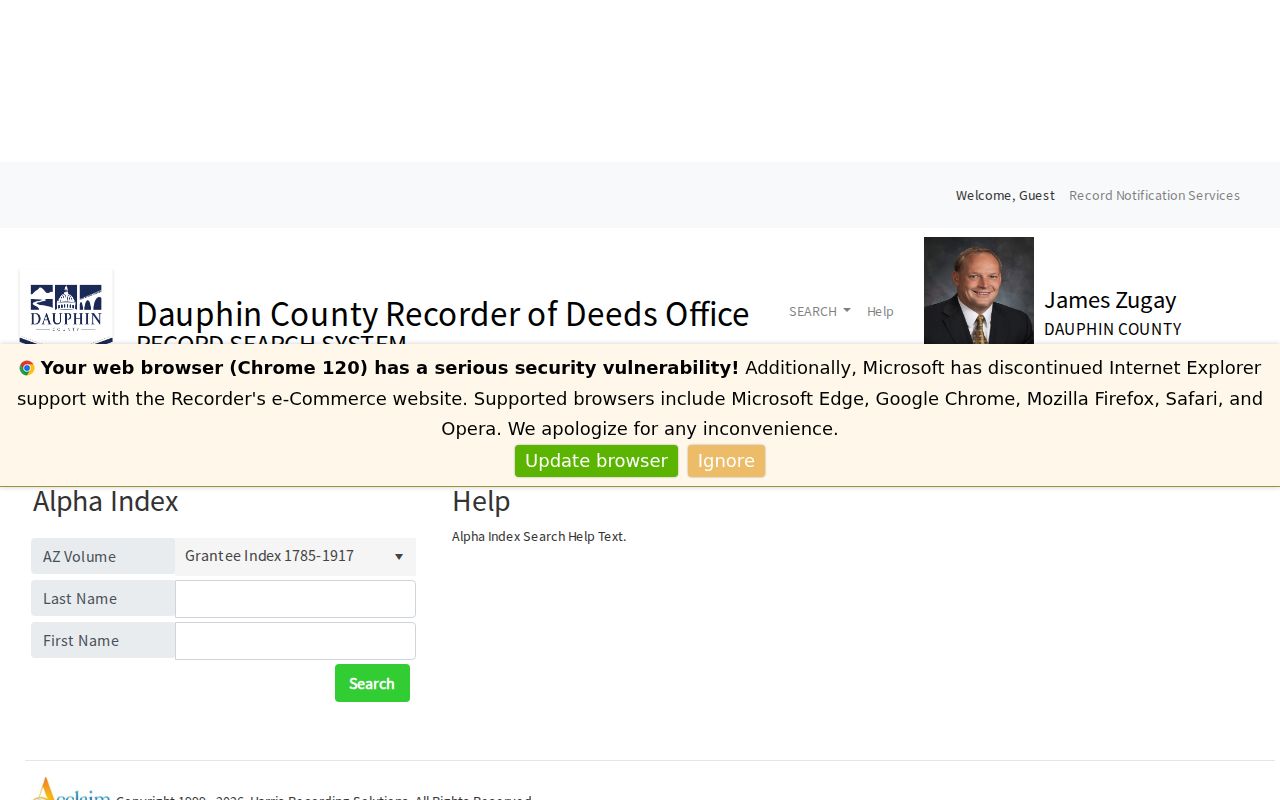
The Alpha Index is a useful fallback for a historical recorded-name trail. Preserve the book, page, document type, and spelling shown by the index before linking the result back to the parcel.
Susquehanna Township Previous Residents Aliases
An old address can disappear from a literal modern search because the Township’s official street appendix records renamings and road changes. In 1953, Pine Street became Twenty-sixth Street, Cherry Street became Herr and Boas Streets, and Walter Street became Wilhelm Road. Later entries include Dauphin Road to Ridgeway Road to Belair Road in 1958, Willow Street to Schoolhouse Lane to Sylvan Place in 1959, and Ararat Boulevard Extension to Vartan Way in 1995.
Before searching a directory, deed comment, map, or newspaper, make an alias pair from the ordinance chronology. Search each record under the label printed in its own period, then compare legal description, plan, lot, block, or UPI. Also keep the Harrisburg postal label where it appears. A Harrisburg city name in a directory can describe a Susquehanna Township address, so the postal label alone does not decide municipal jurisdiction.
Note: The street appendix records dates and locations for changes, which makes it a stronger address-continuity tool than a modern map alone.
Susquehanna Township Past Household Records
Past residents require a second layer after the deed chain. The relevant printed series is Harrisburg City Directories, including nearby and suburban material certain editions carry. HSDC holds documented runs beginning in 1839 and ending in 1999, with gaps that must be preserved. East Shore Area Library has another on-site route: Harrisburg City Directories on microfilm from 1861 through 1901. Neither collection is a continuous Township-only roster.
HSDC describes the volumes as alphabetical lists of residents and businesses with name, address, and usually occupation. Some volumes also have a street-number section, the local criss-cross function. Ask the librarian if the specific year has that section before relying on it for a known address. The Susquehanna Township directory book page covers the collections and their entry-reading details.
A directory line should be copied literally, including the edition year, page, name spelling, street, number, and occupation. A disappearance may reflect a move, death, marriage, coverage choice, name-format difference, or address change. It does not establish one event by itself.
Lawful use. Previous-resident research can support family history, estate questions, house history, and civic curiosity. Do not use names or addresses to stalk, harass, intimidate, or harm any person.
Susquehanna Township Census Pairing
Pair directory years with census years instead of treating either source as complete. Directories supply intervening address and occupation snapshots for available editions. Federal census schedules can add household composition, relationship, age, birthplace, and tenure details for a decade. Public federal population schedules run through 1950, while the 1890 population schedule was largely destroyed in the 1921 fire. That loss is a real break in the evidence, not a reason to invent a continuous resident record.
Work from a dated directory entry to the closest census, then back to the next available directory edition. Compare the street label, number, household names, and age pattern. If the address has changed names, use the Township appendix first. When someone drops from the sequence, DCLS Patriot-News microfilm, HSDC’s death registry, cemetery inventories, church records, Recorder deeds, and Register estate files can provide later evidence.
Note: The 1890 census loss makes adjacent directory editions, newspapers, deeds, and estate material especially valuable for continuity.
Susquehanna Township Structure Evidence
A structure date is not a household date, but it can help test an address trail. The Library of Congress has a 1929 to 1950 Harrisburg Sanborn volume that explicitly identifies parts of Susquehanna Township, Penbrook, Progress, Paxtang, and Swatara. Use the sheet index and secondary location labels before assuming a particular Township neighborhood appears in the volume. The maps show building footprints, use, and street continuity, not names of occupants.
Township permit and plan material is another address-specific source. No public permit-query index was located, so request a known address, date span, and record type through Community Development, its counter route, or a sufficiently specific RTKL request. Property images, assessor year-built fields, permits, plans, and Sanborn sheets can conflict. Treat each as dated evidence and compare it with the recorded parcel trail.
Susquehanna Township Previous Residents Endpoints
An obituary, estate, or recorded estate deed can close a prior-resident trail when a name disappears from an address sequence. HSDC holds a Registry of Dauphin County Deaths for 1893 through 1906, church and cemetery material, will-book extracts from 1785 through 1827, and Orphans’ Court extracts from 1785 through 1817. East Shore’s newspaper microfilm runs from 1946 through 2015. Those records can supply a date, family connection, executor, or publication lead to compare against the address history.
The Dauphin Register of Wills & Clerk of Orphans’ Court is the current custodian for estate, marriage, guardianship, adoption, inheritance-tax, and historical records. Use a precise estate or record request rather than a broad question about a person. A succession trail is most reliable when an obituary, estate file, executor or heir evidence, and recorded deed are compared as separate documents.