
Susquehanna Township City Directory Collections
Susquehanna Township is a first-class township, not a historic incorporated city. Its practical historical shelf is therefore the Harrisburg directory series, which can include adjacent and suburban communities in some editions. The Historical Society of Dauphin County directory collection is the primary long-run source. It documents volumes for 1839; 1842 to 1843; 1852; 1856; 1858; 1860; 1863 to 1864; 1866 to 1867; 1869; 1871 to 1947; 1949 to 1956; 1958 to 1976; 1979 to 1982; and 1986 to 1999. Those gaps matter. The evidence supports a shelf with many years, not an unbroken annual Township census.
| Collection | Years | Where held | Access route |
|---|---|---|---|
| HSDC Harrisburg directory volumes | 1839 to 1999, with documented gaps | Alexander Family Research Library | Library and research-librarian route |
| DCLS Harrisburg directory microfilm | 1861 to 1901 | East Shore Area Library microfilm | On-site microfilm |
| Patriot-News | 1946 to 2015 | East Shore Area Library microfilm | On-site newspaper research |
| Federal census schedules | Public decades through 1950, except most of 1890 | NARA and archives channels | Household snapshot to pair with directories |
The Alexander Family Research Library is at 219 South Front Street in Harrisburg. Its posted public hours are Tuesday through Friday, 1:00 to 4:00 p.m., plus the second Sunday from 1:00 to 4:00 p.m. Nonmembers pay admission, and research help is available through library@dauphincountyhistory.org or 717-233-3462. A directory entry printed under Harrisburg can still belong to a Susquehanna Township address. Check the municipality, street section, and parcel context before discarding it.
Harrisburg Labels in Susquehanna Township City Directories
Postal and directory naming around the capital city edge needs care. Susquehanna Township addresses often use Harrisburg, PA as the mailing locality, even though the parcel lies in a separate municipality. That does not make a Harrisburg listing wrong, nor does the label establish the Township by itself. Search the literal locality and street printed in the source, then compare it with a Dauphin County Property Tax Inquiry parcel card or the Township map tools when jurisdiction matters.
An old resident trail can appear under four useful labels: a Harrisburg directory title, a Susquehanna Township parcel code, a Harrisburg postal ZIP, and an earlier road name. Retaining each source label avoids a false no-match. The Township was formed in 1815, while Dauphin County deeds begin in 1785, so the oldest land or court context can also use a predecessor locality or Paxtang-area description.
DCLS Microfilm for Susquehanna Township City Directories
The East Shore Area Library offers a second physical route into the local series. Its collection page identifies Harrisburg directory volumes from 1861 to 1901 on site, alongside a long Patriot-News microfilm run. DCLS and HSDC complement one another. HSDC carries the broader documented 1839 to 1999 shelf and archival materials, while DCLS provides the focused directory and newspaper microfilm route for on-site browsing.
DCLS describes its microfilm and local-history collection before the image below. 
The library image points to the material that can fill a gap between census decades. Newspaper notices, obituaries, property notices, and social columns can test whether a person who vanishes from a directory moved, died, changed a name, or simply missed a particular volume.
Microfilm access is not an online index. Bring surname variants, approximate years, and the address or occupation already known. Ask staff about reader access and reproduction procedure rather than assuming every page has a digital download. Note: A directory year is evidence for that edition date, not proof of a person’s address at every point in the year.
Reading Susquehanna Township City Directory Entries
HSDC describes the local series as alphabetical listings of residents and businesses, normally giving a name, address, and occupation. These fields are especially useful for separating two people with the same surname. They are historical claims. An occupation or address in an old entry should be compared with another dated source before it is attached to a family history. HSDC’s accessible collection description does not transcribe a Township household line, so the volume itself remains the authority for punctuation, initials, and any marks used in that edition.
| Alphabetical name | Search surname variants and household members separately; a listing can cover a resident or business. |
|---|---|
| Address | Usually a residence or business location; test it against the street section and later parcel naming. |
| Occupation | Usually present and useful for distinguishing same-name people, but not a current-location fact. |
| Street-number section | Some volumes arrange occupants or businesses by street number, creating an address-to-name route. |
| Front matter | May list organizations, businesses, and societies that suggest records to corroborate elsewhere. |
- Criss-cross directory
- A second arrangement by street number that can point from a known address to a dated occupant or business when the volume includes it.
- Householder index
- An alphabetical listing used to locate a named household before checking its address or street context.
- Abbreviation key
- The volume’s own explanation of shortened terms and marks. Inspect it before expanding initials or assuming a status mark.
Do not infer an owner, renter, spouse, or widow notation where the locally available source does not define one. Some editions carry a street section and some do not. Ask the librarian about that specific year before ordering or copying a whole volume for an address search.
Susquehanna Township City Directory Reverse Sections
For house-history work, a street-number section can be more direct than the alphabetical side. HSDC confirms that some Harrisburg-area volumes have that second arrangement. Start with the literal historic address, then scan the appropriate street section if it is present. Record the page, edition year, street spelling, number, and every named business or occupant. This is a reverse-directory function, not proof that every resident of a building appears there.
Street names can defeat an exact modern search. The Township street appendix records that Pine Street became Twenty-sixth Street and Cherry Street became Herr and Boas Streets in 1953. Walter Street became Wilhelm Road in the same year. Use the old and new names as an alias pair. For a present-day parcel, the Dauphin County Recorder Acclaim search can then connect recorded documents through UPI, legal description, or book and page instead of relying on a changing street number.
Tracing Families with Susquehanna Township City Directories
A careful directory sequence joins the short intervals between federal census snapshots. Federal schedules can show household composition, relationships, ages, birthplaces, and other period details. Directory volumes can place a named person or business at a street location in intervening years. Most of the 1890 population census was destroyed, making available directories, deeds, and newspapers particularly useful around that absence. Keep dates separate rather than turning a string of yearly entries into one uninterrupted claim.
- Begin with a verified available edition near a census decade and search the surname plus sensible spelling variants.
- Write down the literal entry, page, year, street or address, and occupation before comparing it with another source.
- Check the street-number section when that volume has one, then note any occupant or business tied to the address.
- Move one available edition backward or forward at a time, preserving the documented gaps in the HSDC run.
- Pair the sequence with census, newspaper, cemetery, church, estate, or deed material to test a move, death, or transfer.
A disappearance has several possible explanations: a move, death, marriage or name-format change, renumbering, a missed edition, or a coverage choice by the publisher. DCLS Patriot-News microfilm, HSDC’s 1893 to 1906 death registry, cemetery inventories, church registers, the Register of Wills, and Recorder records offer separate ways to investigate without treating a missing listing as a conclusion.
Susquehanna Township Archives Beyond Directories
HSDC has about 900 manuscript groups, legal documents, maps, yearbooks, letters, diaries, family, business, agency, church, and military material, plus more than one million photographs. Its holdings specifically identify the Susquehanna Township High School Collection, MG 504; the Susquehanna Township Lions Club Collection, MG 524; and MG 631 for the Susquehanna Township Society for Detecting Horse Thieves. These are archive leads, not current membership lists. A request framed by collection, topic, and date is more useful than a broad name-only demand.
HSDC explains the local directory holdings and their alphabetical and street sections before the image below. 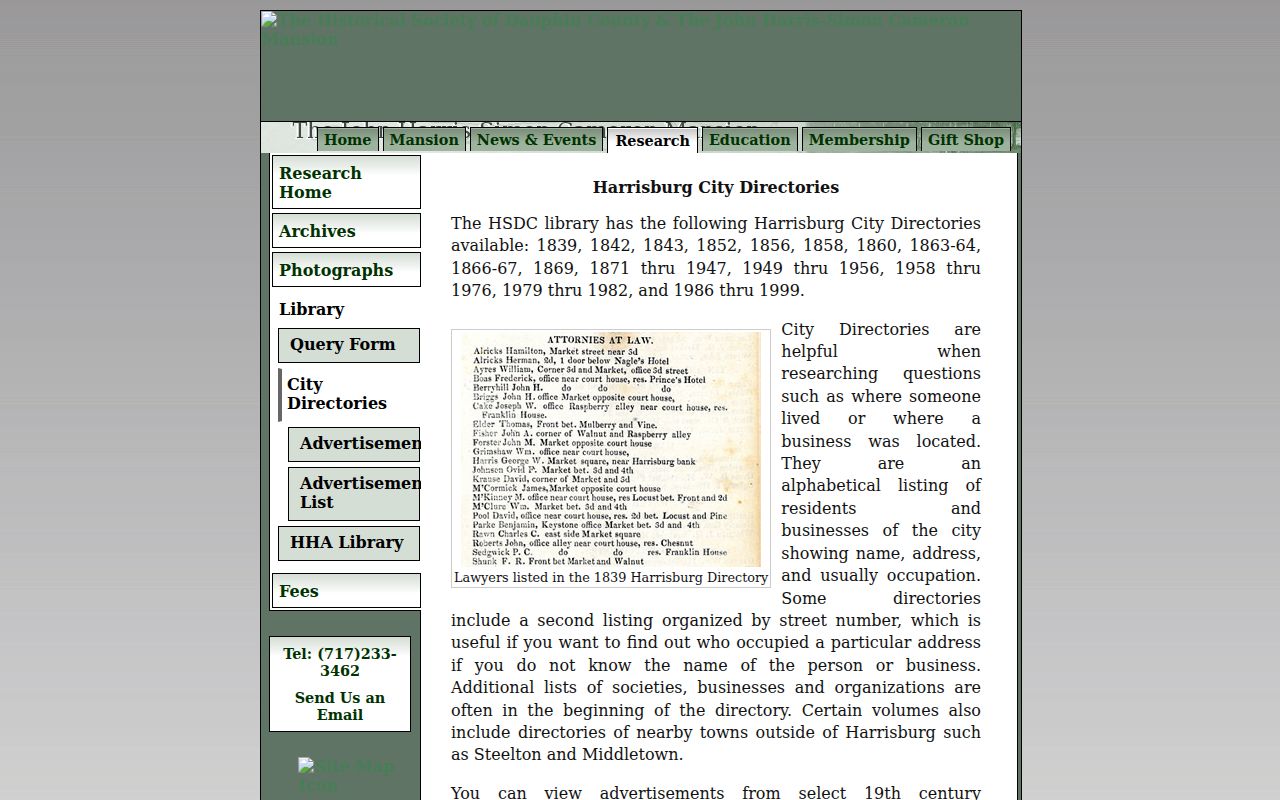
The HSDC directory shelf becomes stronger when paired with its school, church, cemetery, map, and estate-extract material. A former neighbor, school activity, club participation, military unit, or family house can be researched through the archive’s specific collection path, while each repository’s access and copyright rules still apply. HSDC also handles remote research requests through its library; that service can carry a fee.
Susquehanna Township Directory Map Gaps
The local record trail is uneven by design. HSDC’s directory holding begins in 1839 and ends with its stated 1999 run, but it contains gaps. DCLS covers 1861 to 1901 on microfilm. The Library of Congress offers a public-domain 1929 to 1950 Harrisburg Sanborn volume that explicitly includes parts of Susquehanna Township, Penbrook, Progress, Paxtang, and Swatara. Use the sheet index and secondary locality names. The volume does not establish that every Township neighborhood appears on every sheet.
Sanborn maps show building footprint, use, street continuity, and fire-map context rather than household identity. Combine the map with a directory street label, parcel number, deed plan, and the source year. That sequence is especially useful when a Township address carries a Harrisburg postal label or an old road name. Note: A map and a dated directory line can corroborate a location and date, but neither alone establishes a complete household.