
Find Susquehanna Township Residents
Susquehanna Township has no single public household list. Dauphin County keeps an ownership and parcel trail, the Recorder preserves recorded land parties, and Pennsylvania supplies a limited voter-status route. Each answers a narrower question. A parcel card can identify the tax owner and site address. A deed can identify grantors and grantees. A public docket can confirm that a named party appears in a case. None alone proves that a person currently lives at a given home.
For a fresh lead, use the address or name already in hand and preserve the record number that comes back. For an older family question, annual directories, obituaries, deeds, and censuses work better together than one search result. The Township’s own permits and plans are another address-based source, but no public permit index was located. A precise Right-to-Know request is the appropriate fallback for an existing municipal record.
- Search the County Property Tax Inquiry by owner, street, number range, or parcel number. Select 62 - SUSQUEHANNA TWP when narrowing the countywide results.
- Compare the site address, owner and tax-mailing fields on the parcel card. They describe a tax record, not every person at the address.
- Take the parcel identifier or sale document number to the Recorder’s Acclaim index and check the recorded party roles.
- For a dated household trail, use the Harrisburg-area directory holdings and newspaper microfilm at the local-history collections.
- Ask the custodian for a specific existing record when the online result is incomplete, keeping a copy of the request and any record identifier.
Susquehanna Township Records Desks
Most Susquehanna Township resident records are kept by Dauphin County or Pennsylvania, not by the Township. The Recorder holds the land-document index. Tax Assessment maintains the parcel card. Registration and Elections handles voter records. The Township administration and Community Development offices are the route for local permits, plans, and other existing municipal records. The address-level workflow belongs in the Susquehanna Township street directory; these desks identify the custodians.
Dauphin County Recorder of Deeds
Room 102, 101 Market Street
Harrisburg, PA 17101
717-780-6560
Dauphin County Tax Assessment
Administration Building, 2 South Second Street
Harrisburg, PA 17101
717-780-6101
Dauphin County Registration and Elections
County office and official voter-status route
Harrisburg, PA
717-780-6360
Susquehanna Township Parcel Search
The Dauphin County Property Tax Inquiry is the practical start for an address or known owner. It is free to use without a login. The search offers Parcel Number, Owner Name, House Number Low and High, Street Name, sale-price and sale-date ranges, plus municipality, neighborhood, building-type and property-class filters. Choose the observed municipal value 62 - SUSQUEHANNA TWP to separate Township parcels from a countywide search.
| Devnet field | Best use | Limit |
|---|---|---|
| Owner Name | Find a tax-account holder | It is not a present-occupant search. |
| Street Name and number range | Find parcels along a segment | Use the Township filter to narrow results. |
| Parcel Number | Return to one known tract | Keep it for later recorder and map work. |
| Sale date or price | Reduce a long property result set | A sale row needs deed confirmation. |
The Property Tax Inquiry screen shows the county’s address, owner, and filter workflow. Its results are best used as a lead to the card and the recorded document, not as a household list.
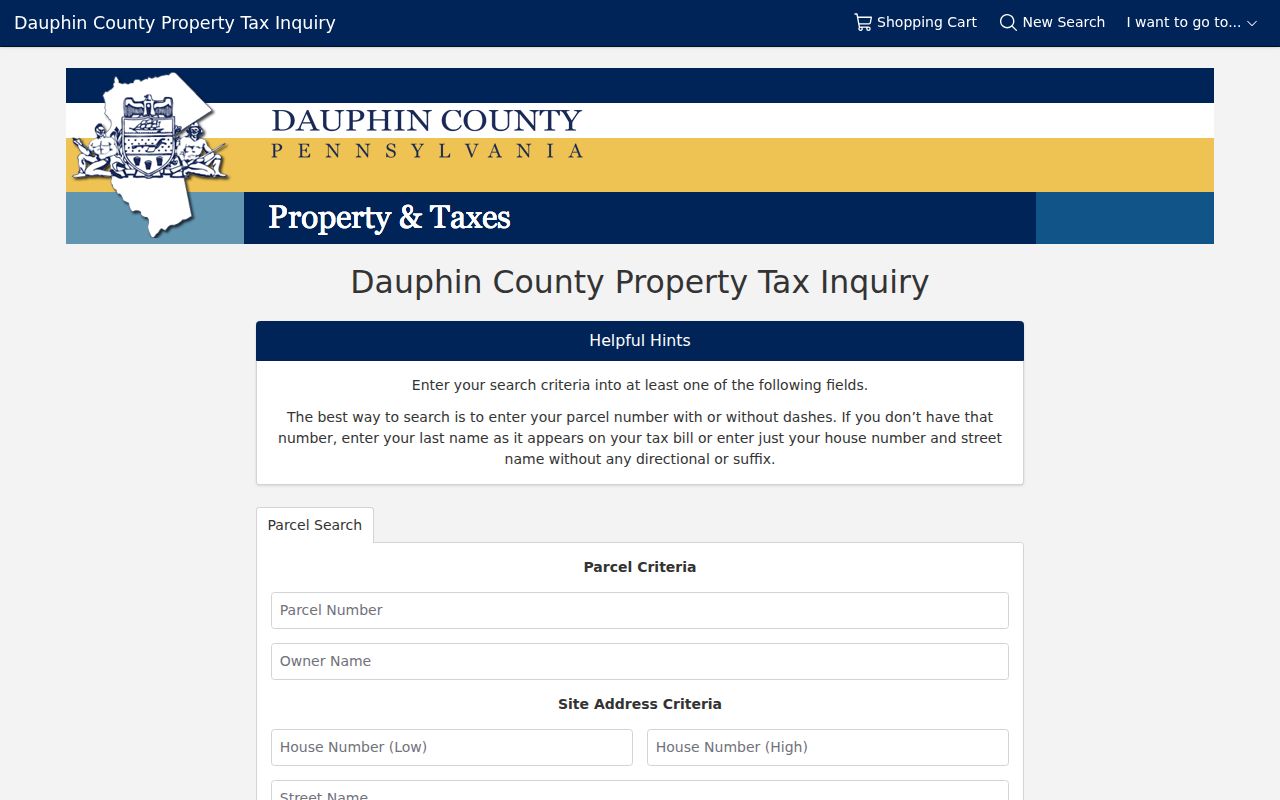
Once a parcel opens, compare its site address, mailing name and address, tax year, sales history, and related-name labels before drawing any conclusion.
Susquehanna Township Parcel Keys
A Uniform Parcel Identifier, often shortened to UPI, is the durable bridge when an address has changed or appears differently in two systems. Dauphin County requires a UPI on real-estate documents recorded after May 1, 2009. The same parcel key can connect the tax card, Recorder index, County GIS, zoning map, and a plan. It is more reliable than guessing from a house number alone.
- Parcel or UPI
- A County identifier for a separate tract, lot, or parcel.
- Site address
- The physical taxable-property location shown on the card.
- Mailing address
- The address where tax notices go. It may differ from the site address.
- Instrument number
- The Recorder’s identifier for a recorded document, useful for returning from a sale row to the document index.
On the inspected Township-owned parcel card, Sales History shows year, document number, sale type, sale date, sold-by, sold-to, and price. The card also displays owner, mailing and site fields, tax status, values, property images, exemptions, and related names. A related name labeled PARCEL OWNER should not be recast as an occupant. Note: a different mailing address may show a tax preference, agent, trust, or off-site owner rather than a new resident.
Recorder Trails for Township Addresses
The Dauphin County Recorder Acclaim search provides deeds and miscellaneous documents from 1785 to the present, while its stated mortgage coverage runs from 1979 to the present. That split matters for a family or property history. A pre-1979 ownership trail may still be strong through deeds, but it should not be described as a complete online mortgage trail.
| Acclaim control | How it helps a resident trail |
|---|---|
| Name | Search a recorded party using last name, then first name; the interface requires at least three characters. |
| UPI Number | Connect a known tax parcel to land documents. |
| Book/Page or Instrument# | Return to a document identified on a parcel sale row. |
| Document Type and date | Focus on deeds, corrected deeds, plans, easements, mortgages, releases, liens, or name-address changes. |
The Recorder search screen exposes the distinct search modes, including Alpha Index and municipality/comments. Keep the legal description, UPI, book/page, and instrument number from each hit because those fields hold a chain together.
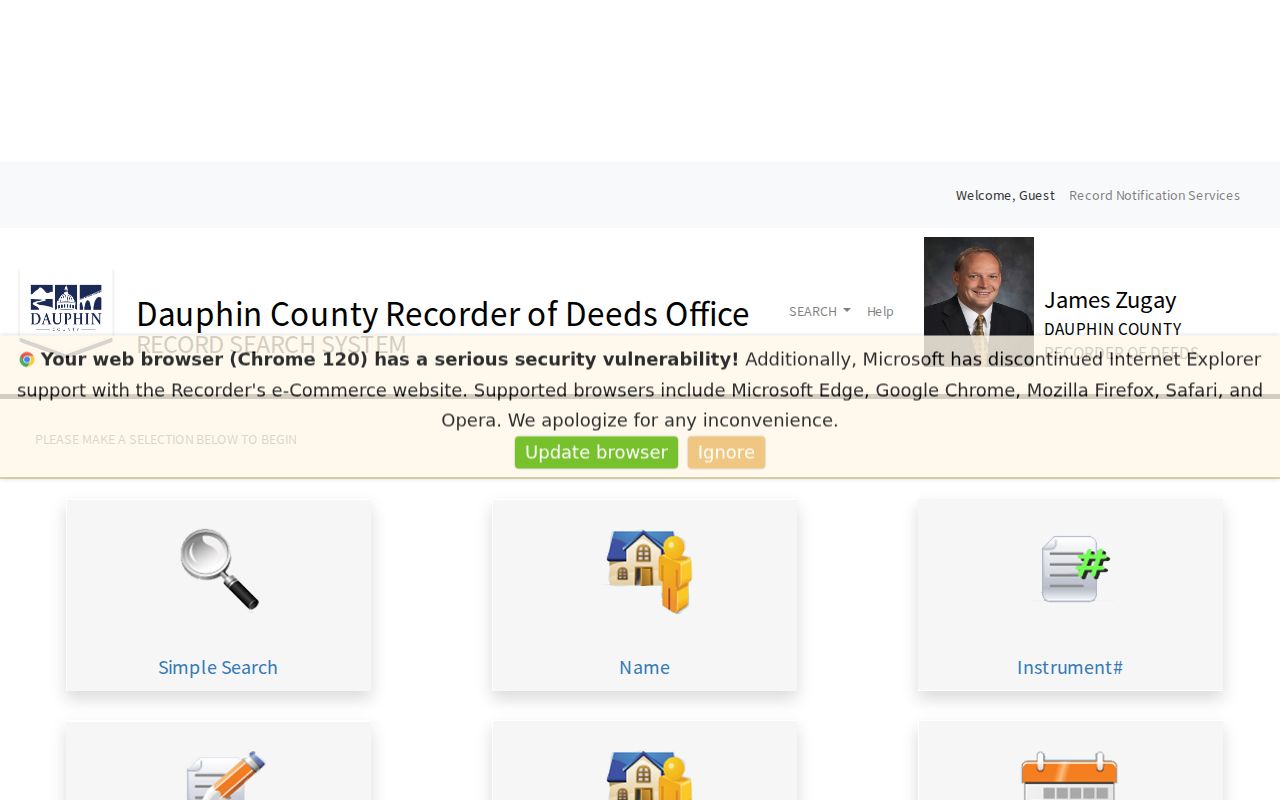
A recorded party is evidence of a land transaction. It is not proof of a present address or a complete account of everyone connected with a home.
Voter Records in Susquehanna Township
Pennsylvania’s Find Voter Registration Status route is a self-service status and election-information check, not a public browseable roster. Its name workflow uses first name, last name, County, and date of birth, with a voter-ID alternative in the current form. Select Dauphin County for a Township address. Treat the result as a protected identity check and do not republish the date of birth used to qualify it.
The broader public-information list follows 25 Pa.C.S. §§1207 and 1404. The State’s form identifies an access and permitted-use process; it lists a $20 request for a county or statewide full voter export and requires written use certification. Electronic signatures and SURE registration numbers are excluded. Voting history can show participation, never ballot choices. A protected voter may have an ACP substitute address, so an absent address is not proof that a person has moved.
The official voter-status form illustrates the controlled fields that distinguish a personal status check from a neighborhood directory.
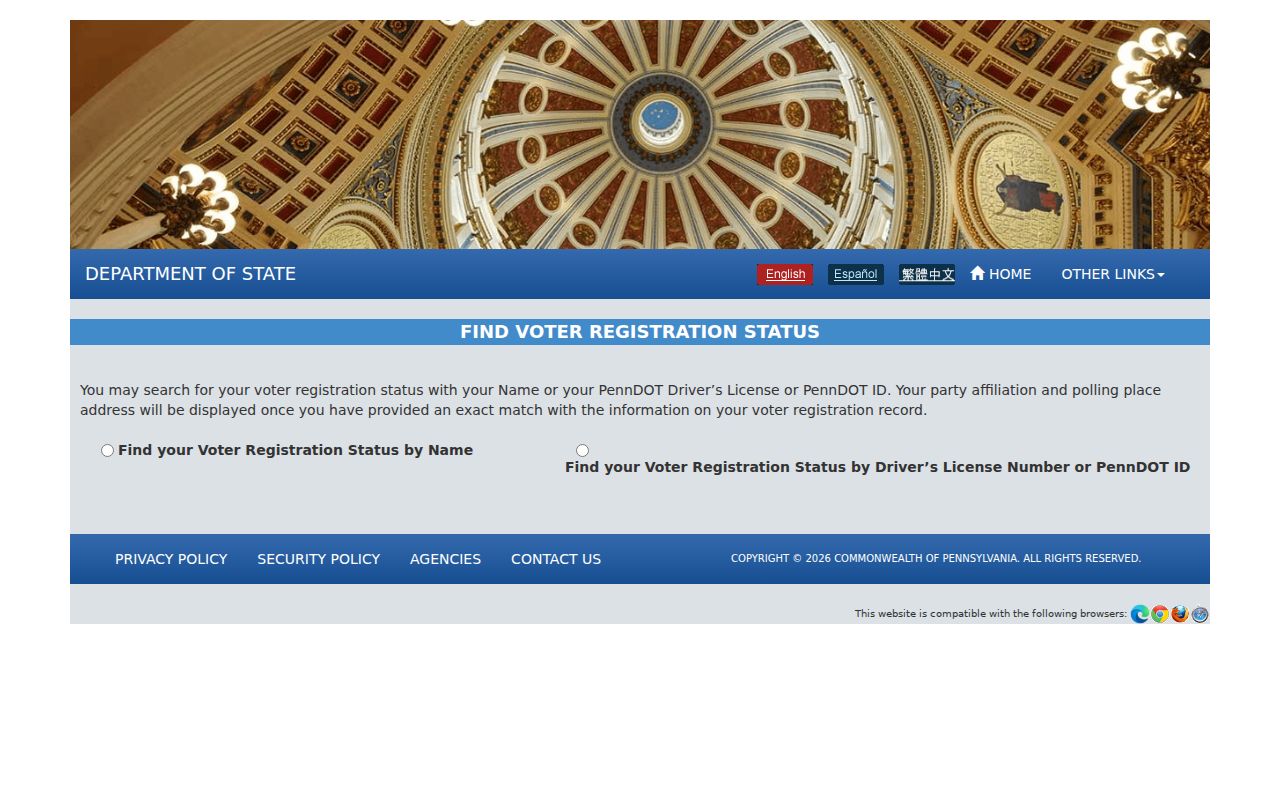
For a lawful request or a registration question, the County Registration and Elections office is the local contact rather than a street-by-street web query.
Current Susquehanna Township Directories
Current resident evidence comes in separate, limited records. The County parcel card identifies an owner, an address, and tax-account data. The Recorder identifies people who signed or were named in recorded documents. A voter-status result applies to the qualifying individual, while a voter list has a controlled request route. Court dockets identify parties in public matters. Each record belongs to its own custodian and must be read for what it actually says.
| Source | Who It Lists | Keeper | Access |
|---|---|---|---|
| Property Tax Inquiry | Tax owner, site and mailing fields | Dauphin Tax Assessment | Free portal |
| Recorder Acclaim | Recorded deed, lien, plan and mortgage parties | Recorder of Deeds | Public search after disclaimer |
| Voter status or public list | Status check or allowed public-information fields | State and County Elections | Self-service or controlled request |
| UJS and CountySuite | Parties and public docket events | Courts and Prothonotary | Free docket view; limits apply |
| Register public search | Estate, marriage and Orphans’ Court leads | Register of Wills | Registered-user search/view route |
Use the exact title or field label shown in a result. A court party is not necessarily a current resident, and an owner’s mailing address may not be the property site. For a name-first verification sequence, use the Susquehanna Township resident lookup workflow.
Court Paths for Township Names
The statewide Pennsylvania UJS Case Search is the public starting point for Magisterial District Judge, Court of Common Pleas, Philadelphia Municipal Court, and appellate docket searches. Dauphin County’s instructions call for Case Information, Case Search, Participant Name, County Dauphin, and Docket Type Criminal, then the D icon for case detail. A docket identifies a court event and party role. It does not establish a home address.
For civil matters filed in the County, the CountySuite Civil Case Search is another route. The Prothonotary warns that a case-management transition can leave some records outside the web system, with the official record at the office. Sealed, expunged, juvenile, adoption, and sensitive family material may be unavailable or restricted. A web no-result therefore is not a countywide no-record conclusion.
The UJS case-search interface supports the county and docket-type narrowing needed to avoid a common-name mismatch.
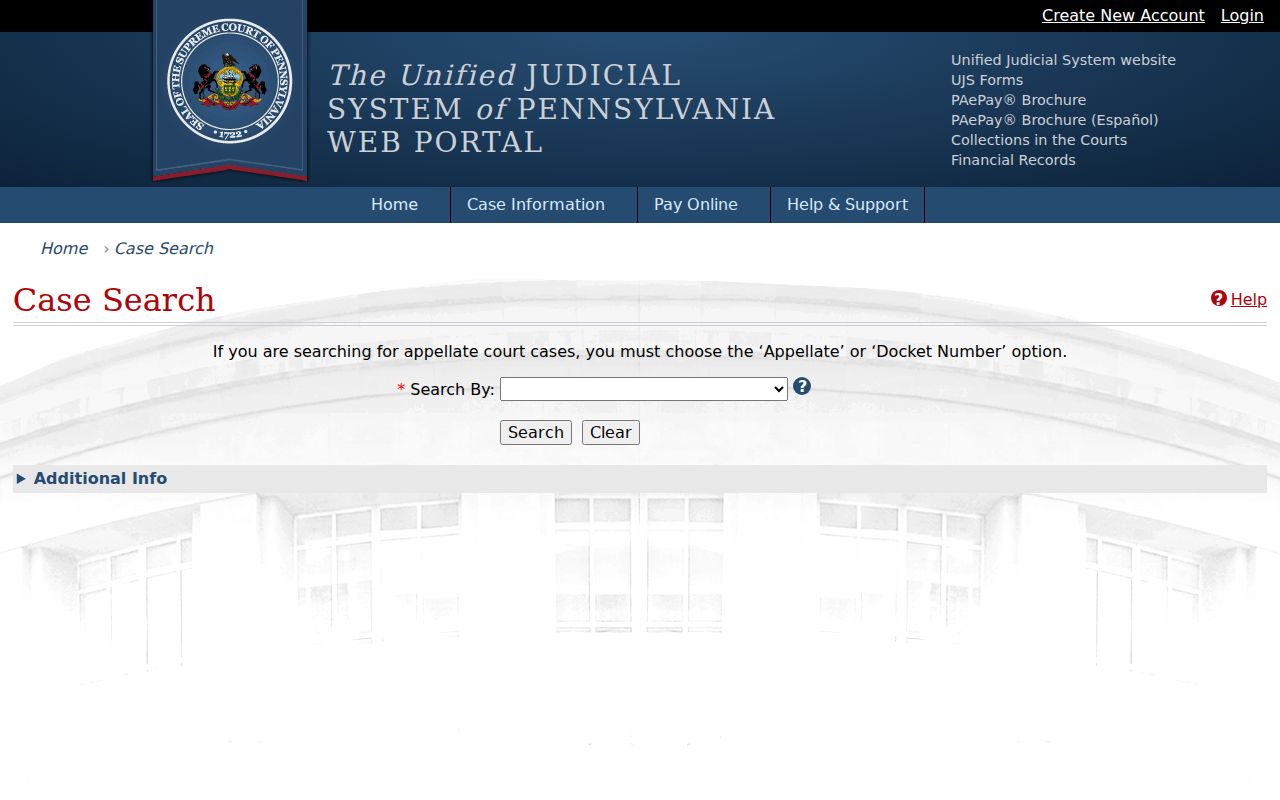
When a docket matters, identify the court, docket number, party role, and event date before contacting the clerk about an official file or copy.
RTKL for Township Records
Pennsylvania’s Right-to-Know Law is Act 3 of 2008, 65 P.S. §§67.101–67.3104. It is a way to request existing public agency records, not a command that staff create a person search. The Susquehanna Township public-records policy directs requesters to its form and asks for enough detail to locate the record. A good request gives an address, date range, document type, and sought fields, such as final permit number, work description, issue date, and named applicant or owner, with exempt personal information redacted.
The Office of Open Records says a written response is generally due within five business days under 65 P.S. §67.901. Section 67.902 allows one written extension of up to 30 calendar days in stated circumstances. Filing is free, although authorized duplication, postage, certification, or actual reasonable costs may apply. A fee estimate above $100 may require prepayment under §67.1307.
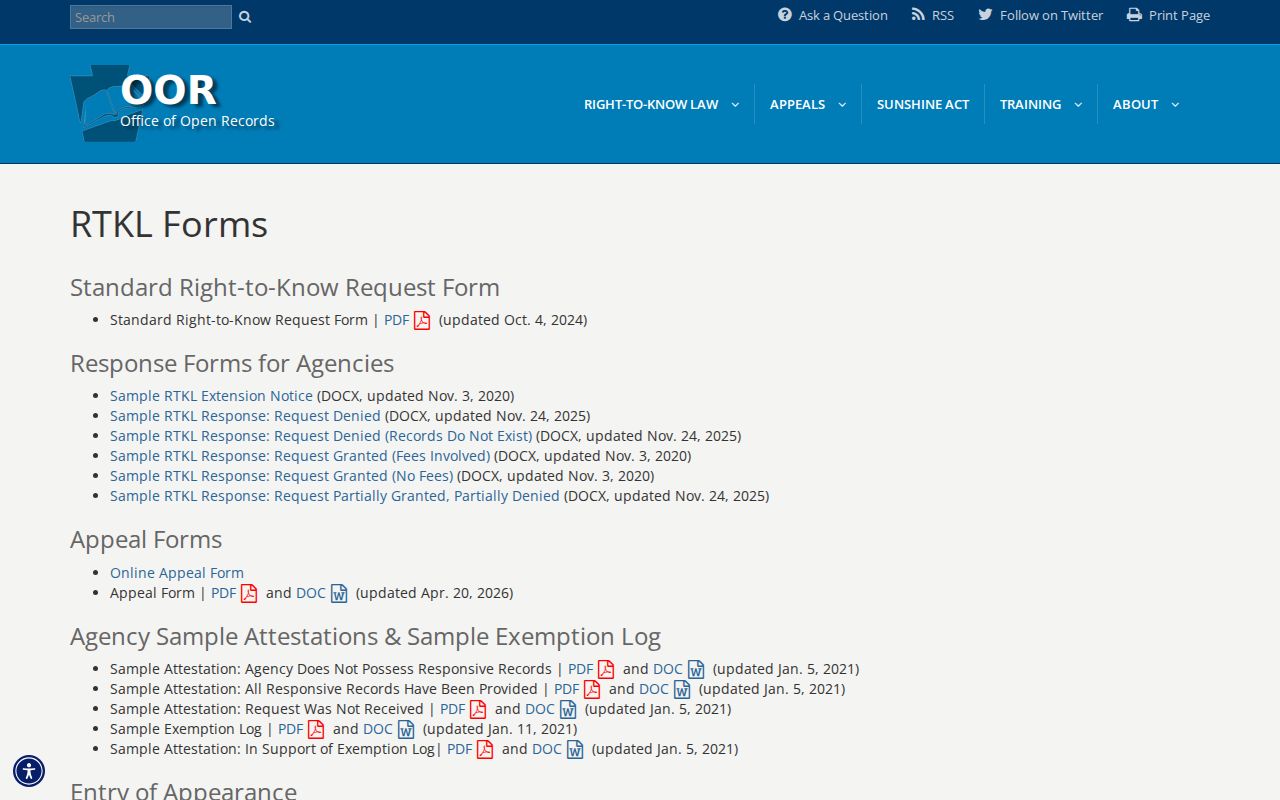
The Pennsylvania RTKL forms page provides the standard request form that every agency must accept.
For Township policy questions, the research identifies Lee Ann Hoffman, Executive Assistant and Assistant Open Records Officer, at 717-909-9222.
Pennsylvania Vital Record Time Locks
Birth and death certificates are not open-ended name-search tools. Under the Vital Statistics Law of 1953, §801, 35 P.S. §450.801, Pennsylvania birth records become public 105 years after birth and death records become public 50 years after death. The Department of Health issues certified records under its own eligibility and identification rules. The State Archives holds mature originals and offers a separate historical-copy channel.
The research records a $20 Department of Health certificate fee and a $5 non-certified archival copy route when required identifiers are supplied. For a pre-1906 event, use the County register, church, cemetery, newspaper, and archival collections rather than assuming one statewide record exists. Dauphin County’s Register of Wills also has the county marriage-license role dating from September 30, 1885.
Note: an archival index or non-certified copy can support family history, but it does not replace the custodian’s certified-record process.
Historical Susquehanna Township Directories
Susquehanna Township residents often appear in Harrisburg-area directory resources because Harrisburg is the postal city. The Historical Society of Dauphin County’s Alexander Family Research Library holds city-directory runs from 1839 through 1999, with documented gaps and separate editions. DCLS’s East Shore Area Library offers Harrisburg City Directories on microfilm for 1861 through 1901 and Patriot-News microfilm from 1946 through 2015. Search the source’s literal city, street, and municipality labels rather than treating a Harrisburg mailing label as municipal proof.
Most directory entries organize a name with an address and occupation. Some volumes have a street-number section that works in reverse, from address to household or business. Read the volume’s own abbreviation key before expanding initials, spouse marks, or status markings. Combine a yearly entry with a deed, obituary, estate record, or census before making a family conclusion. The fuller collection guide is in the Susquehanna Township directory book.
Old Susquehanna Township Street Names
An exact address search can fail because a road name changed. The Township’s street and sidewalk appendix records opening, renaming, vacation, and acceptance actions with dates and locations. It identifies a 1953 change from Pine Street to Twenty-sixth Street and a 1953 change from Cherry Street to Herr/Boas. The same historical location may also carry a Harrisburg postal label, Township parcel code 62, a Harrisburg ZIP, and an older road name.
Build an alias pair before searching a directory, deed, map, or newspaper. Try the old and new forms separately, then use the parcel key or legal description to decide whether the references point to the same tract. This small step avoids a false no-match when the source uses an earlier street label.
Note: street-name chronology establishes a search vocabulary; it does not, by itself, establish property ownership or household membership.